Castor Oil for Wrinkles? Why It Can Be Worth Adding To Your Routine

There are a ton of claims about castor oil out there, some true and some, welp, not entirely true. But the bottom line is this: It can make your skin softer, help ease any dryness and irritation, and leave it looking smoother than it did before. And it only costs a couple of dollars. As Ina Garten says, what’s not to love?!
If you buy through our links, we may earn a small commission at no cost to you. As an Amazon Associate, we earn from qualifying purchases. Our policy
Well, there’s a few things. But once you know how to get the most use out of it, the benefits will follow.
TLDR: Castor oil functions primarily as an occlusive that sits atop the skin, creating a protective barrier to lock in moisture and protect your skin against environmental stressors.
The key is not to use it like a treatment product. Instead, treat it as a finishing product in your nighttime routine, the one that seals in everything you put on before it. Applied that way, it becomes an inexpensive luxury that gives back more than you’d expect.
How Castor Oil Works on the Skin
Castor oil contains approximately 90 percent ricinoleic acid. This is the primary component that creates its thickness and viscosity. Once applied, castor oil acts similarly to other occlusives (ingredients that form a protective barrier over your skin). In other words, it forms a physical barrier that helps prevent moisture loss. As our skin ages, it holds onto water far less easily than younger skin (sigh), so of course the skin struggles to stay hydrated. By sealing in the moisture that’s already there, castor oil helps skin hold it longer, so it can look smoother and more plump.
Castor oil also possesses a calming property. Ricinoleic acid has demonstrated anti-inflammatory properties, so when applied to red, inflamed areas of skin, it’s been shown to soothe them (Mediators of Inflammation, 2000). So if your skin tends to get reactive or inflamed, applying a thin layer of castor oil to those areas may bring some relief.
Because it seals so well, it also works as a buffer for stronger actives. (Which means it’s great for layering/sandwiching). For example if a retinoid or exfoliating alpha-hydroxy acid causes stinging right after you apply it, a thin layer of castor oil over the area can ease that discomfort without negating what the active is doing below. Hooray!
From the Hive
The buzz from our Beauty Empties Experts. Sign up to join!
Our BEEs are split on castor oil, but the ones who love it almost all use it the same way: blended into a moisturizer or layered over their other products at night, never straight from the bottle. Mixed into a night cream or patted over a retinoid, they say it leaves skin softer and more glass-like by morning. The tip that comes up again and again is to dilute it, since on its own it can feel heavy.
One Study Worth Knowing
Most of the information out there regarding castor oil is far beyond scientific evidence. However, there is one important exception. A 2024 study published in the Journal of Cosmetic Dermatology examined whether a castor oil-based eye cream applied under the eyes twice daily for 60 days could lighten dark circles, and the people in the study actually saw their under-eye pigment measurably lighten.
I wouldn’t put a ton of weight in that study since it wasn’t controlled, but there’s reason to hope! A few of our BEEs swear by it under the eyes specifically, saying the area looks less dry and creased after a few weeks of nightly use. Which is a win in our book.
How to Use It
To get the most out of castor oil, a few basics help. Purchase cold-pressed, hexane-free castor oil, which means the seed was pressed mechanically instead of through heat, and no chemicals were used to extract the oil. You’ll want to test for allergic reactions on your inner forearm for 3-5 days before using it on your face, because castor oil is recognized as an allergen in a small percentage of people (Contact Dermatitis, 1997). After using every other product in your nighttime routine, warm up 2-3 drops of castor oil between your fingers and gently massage into the drier sections of your face.
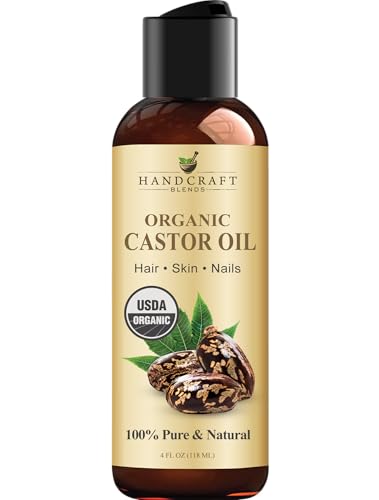
Handcraft Organic Cold-Pressed Castor Oil
A cold-pressed, hexane-free castor oil in a glass bottle, exactly the kind to reach for as a comforting nighttime seal.
Castor oil can be extremely thick and difficult to distribute evenly. Mixing in 1-3 drops of a thinner oil (for example, rosehip or jojoba) can help make the application easier, and it can sometimes produces a mixture that performs better than pure castor oil.
The Combos Worth Trying (and the One to Skip)
There are a ton of combinations created with castor oil that are shared all over social media. Most are great as moisturizing routines. Some examples include:
- Rosehip and castor oil: combine the lightweight hydration of rosehip with the sealing power of castor oil.
- Vitamin E, rosehip, and castor oil: get antioxidants from vitamin E, hydration from rosehip, and a castor oil seal over the top.
- Aloe vera and castor oil: a cool, lighter, hydrating blend designed for oily skin.
- Coconut oil and castor oil: you can thin out thick castor oil using coconut oil, though some people break out from coconut, so patch test first. (I am one of those people.)
- Turmeric and castor oil: anti-inflammatory properties from turmeric, but turmeric stains everything (yes, your fingers will turn orange), so use a minimal amount.
One important tip. Avoid anything lemon. A study founds that applying citrus juice to the skin, followed by exposure to sunlight, can lead to severe burns including blisters (Wounds, 2017).
From the Hive
Not every BEE is sold, and the honest split is worth hearing. Some with oilier or breakout-prone skin found castor oil clogged them or made their pores look bigger, and a few felt it was too heavy or even drying over time. It’s exactly why they lean on the patch test and the dilute-first rule, and why most treat it as a comfort step rather than a must-have for everyone.
What to Expect (and What It Won’t Do)
If you set your expectations right, castor oil generally delivers. Users say they experience softer, more comfortable, better-hydrated skin with smoother-looking fine lines while using it. However as with most skincare, don’t expect it to rebuild collagen or erase wrinkles permanently. When it comes to anti-aging, castor oil does not have the studies to match retinoids (Clinical Interventions in Aging, 2006). And please, despite what you might read online, do not confuse it with sunscreen. It measures around SPF 6 in laboratory tests (Pharmacognosy Research, 2010). Use a real SPF during the day and keep castor oil to nighttime. If you keep all of that in mind, a few dollars of castor oil is one of the simplest upgrades a dry-skin routine can get.
Castor Oil for Hair, Scalp, and Brows
Castor oil’s other claim to fame is hair, and this is where the gap between hype and evidence is pretttttty wide. I was surprised there are actually no human studies showing it grows hair, fills in a thinning scalp, or lengthens lashes and brows. A 2022 systematic review in the Journal of Drugs in Dermatology went through the research and found no strong evidence for castor oil and hair growth, only weaker support for making hair look shinier.
What it basically acts as is a conditioner. It coats the strands, can smooths frizz, and add shine and “slip,” which is most of what people are noticing when they talk about the benefits. On the scalp, its main fatty acid has shown to be anti-inflammatory in lab studies (Mediators of Inflammation, 2000), so a little massaged into a dry, flaky scalp can feel soothing, even if that hasn’t been tested for dandruff specifically. The same goes for brows and lashes: it can make them look glossier and fuller, but has not actually been shown to grow them.
Two real, icky cautions, though. Castor oil is thick enough that heavy use on long hair has been known to cause matting. There’s a documented case of hair felting so badly after a castor oil treatment that it had to be cut off (International Journal of Trichology, 2017), so use a small amount and comb it through instead of slathering it on. And keep it away from your eyes. The American Academy of Ophthalmology warns against this, since the castor oil on store shelves isn’t sterile and can irritate and/or scratch the surface of the eye. Stick to the brow or lash line, sparingly, and always use a clean spoolie.
A cruelty-free mark means the brand is certified by PETA, Leaping Bunny, or both at the time of writing. A missing mark doesn’t mean a brand tests on animals; it just means the brand isn’t certified by these programs.
What Our BEEs Are Buzzing About
Here’s what the beauty community is saying about castor oil:
Want to become a Beauty Empties Expert?
BEEs get free products to test, exclusive discount codes from our brand partners, and live access to The Hive sessions with dermatologists and beauty editors. Spots are limited and hand-picked.