Anti-Aging Skincare Ingredients Everyone Over 40 Should Know About
When you hit forty, chances are you’ve bought more skincare than any number of beauty editors. And you’ve likely got a pretty good idea of how your skin reacts to different products. But getting past the noise is where the challenge is. There are thousands of serums out there, all claiming to do the same things, the ingredient lists read like a chemistry textbook, and any real evidence gets buried under all the marketing.
If you buy through our links, we may earn a small commission at no cost to you. As an Amazon Associate, we earn from qualifying purchases. Our policy
There are a handful of things that definitely change in your skin after 40. As estrogen levels begin to decline during the years surrounding menopause, so too will some collagen and surface moisture. That’s why the same moisturizer that helped carry you through your thirties may start to feel like it’s no longer doing enough. On the other hand, there’s a relatively small pool of ingredients that’s got solid science behind it specifically for this life stage. Below are eight ingredients worth knowing, what each one does, and what the science says.
Sunscreen (SPF)

EltaMD UV Clear SPF 46
An oil-free zinc sunscreen dermatologists reach for first, light enough to wear under makeup every single day.
If you’re going to add only one product to your daily routine, make it sunscreen. It’s possibly the least exciting product listed, but the science is unarguably one of the strongest. Most of what we perceive as aging visually, the uneven tone, texture, and loss of firmness, can be directly linked to years of cumulative UV exposure, regardless of your actual age.
The evidence here is about as strong as skincare gets. In 2013, researchers conducted a large randomized controlled trial in the Annals of Internal Medicine using approximately 900 adults over four-and-a-half years. The group that applied sunscreen daily didn’t show any measurable increase in skin aging, whereas the group instructed to apply it only occasionally aged at the normal rate, roughly 24 percent more. So apply it every day, rain or shine, whatever the plan is for that day.
From the Hive
The buzz from our Beauty Empties Experts. Sign up to join!
Our BEEs are unanimous on this one. The ones who started wearing sunscreen young and never stopped say the payoff is impossible to miss, and more than a few report getting mistaken for a decade younger than they actually are.
Retinoids (and Bakuchiol, the Gentler Alternative)

RoC Retinol Correxion Deep Wrinkle Night Cream
A drugstore retinol that’s been studied for decades, an easy and affordable first step into retinoids. Certified cruelty-free (PETA).
Retinoids are the vitamin A family, from prescription-strength tretinoin at one end to over-the-counter retinol and retinaldehyde in the middle. They’re arguably the most effective way to stimulate cellular turnover and the production of collagen, the primary structural protein responsible for keeping skin firm, and the one whose production declines significantly after 40.
The most compelling study on retinoids was published in 2007 in the Archives of Dermatology. Researchers studied older adults who applied 0.4% retinol to the skin. The results showed significant increases in collagen content and reductions in fine wrinkling compared to untreated subjects, and they came from skin that had aged naturally, not from sun exposure. If retinol causes irritation, flakiness, or redness (all more common with the drier skin that comes after 40), consider switching to bakuchiol, a plant-derived retinol alternative made from the babchi plant. A 2019 study in the British Journal of Dermatology comparing retinol and bakuchiol found both produced equivalent improvements in surface smoothing and brightness, though bakuchiol caused significantly less irritation. Use either product two or three times a week to start, and increase frequency as your skin tolerates it.
From the Hive
Retinoids are the active our BEEs swear by most after sunscreen. Plenty have used some form for decades and credit it for the few lines they have, and several point out that you can move from prescription tretinoin to a gentler over-the-counter retinol later on and still see results. They’re honest that it takes patience and the right strength, and that pushing too hard tends to backfire.
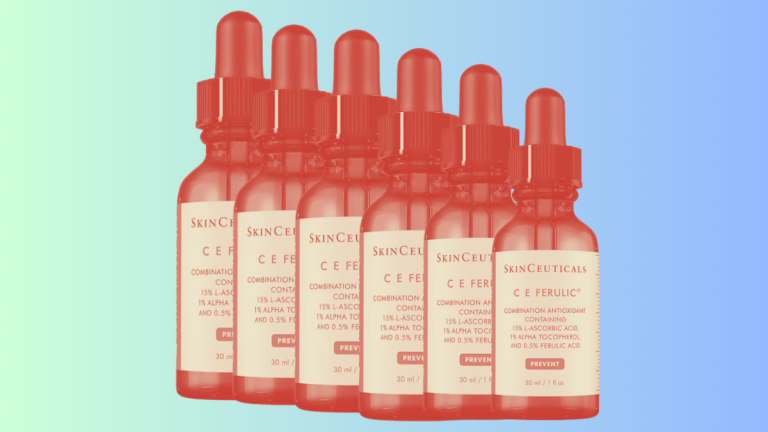
Vitamin C

La Roche-Posay 10% Pure Vitamin C Serum
A 10% pure vitamin C serum with hyaluronic acid, packaged in an opaque tube so it stays potent.
Vitamin C acts as an antioxidant, protecting your skin from the constant damage caused by pollutants and sun exposure before those damaging effects destroy collagen. Vitamin C also helps reduce the appearance of brown spots (hyperpigmentation) that become increasingly prevalent as we age.
A 2017 review article published in Nutrients laid out the mechanism. Vitamin C is essential for the activity of the enzymes involved in assembling and stabilizing collagen, which is part of why topical forms keep turning up in anti-wrinkle and firming results. When used under sunscreen in the morning, vitamin C gives the SPF a little backup against UV damage. Look for it in a tube or an opaque bottle, since it breaks down in light and air.
Our BEEs who’ve stuck with a vitamin C serum for years tend to be its biggest fans, crediting it for brighter, more even skin and fewer spots over time. The reminder they pass along is to actually use it up, since it loses strength once it’s been open a while or starts to turn orange.
Peptides

The Ordinary Matrixyl 10% + HA
The Matrixyl peptide from the study, at a price that makes it easy to keep in steady rotation. Certified cruelty-free (PETA).
Peptides are short chains of amino acids (the building blocks of proteins), and certain ones signal your skin to make more collagen. Peptides are a great pick for firmness, with little of the irritation retinoids can cause, which is one reason the two pair so well together.
They’re subtle compared with retinoids, and the research bears that out. A 2005 study published in the International Journal of Cosmetic Science evaluated a palmitoyl pentapeptide labeled Matrixyl on 93 women and observed marked reductions in wrinkles and fine lines after 12 weeks compared to a placebo cream. Think of peptides as a long-term supporting player in a skincare routine.
Peptides win our BEEs over slowly rather than overnight. The ones who stick with them report softer lines around the eyes, with the honest caveat that the results fade if you stop, so they only pay off if you keep them in the rotation.
Niacinamide

The Ordinary Niacinamide 10% + Zinc 1%
The cult niacinamide serum for tone, oil, and barrier support, gentle enough for daily use. Certified cruelty-free (PETA).
Niacinamide is a multitasker that strengthens the skin barrier (the outer layer that holds moisture in), evens out tone, calms redness, and pairs extremely well with virtually every product in a skincare routine, retinoids included.
Studies back up its effectiveness on several fronts. A 2005 study published in Dermatologic Surgery used 5% niacinamide for 12 weeks on women with photoaged skin. Significant improvements were noted across the board: fewer fine lines, fewer dark spots, less blotchiness, less sallowness, and better elasticity, all compared to a control cream. At 5%, niacinamide stays well tolerated on even sensitive or reactive skin types, which is why it appears so frequently in skincare routines at this stage.
Niacinamide is the multitasker our BEEs reach for when they want help with tone and texture without much fuss. Many say it smoothed their pores and calmed redness where pricier products fell short, though a few with reactive skin do find it irritating and patch-test before committing.
Hyaluronic Acid

Neutrogena Hydro Boost Hyaluronic Acid Serum
A lightweight hyaluronic acid serum that layers easily under moisturizer for a quick hydration boost.
Hyaluronic acid is a moisture magnet, able to hold many times its own weight in water. Since your skin makes less of its own as you get older and holds onto less water overall, topping it up plumps the surface, softens fine lines, and gives skin some bounce.
Because it works on the surface, the effect is real but short-lived, which is exactly why it’s an everyday step. A 2011 study published in the Journal of Drugs in Dermatology found that topical hyaluronic acid improved hydration and elasticity over a period of two months. Lighter-weight formulations penetrate slightly more deeply and also reduced wrinkle depth. Once applied to damp skin and sealed with another product (to prevent rapid evaporation), hyaluronic acid becomes an incredibly versatile part of a moisturizing routine.
From the Hive
Our BEEs have a hard-won tip for hyaluronic acid. It really only works on damp skin sealed with a moisturizer on top, and used dry, more than a few found it left their skin tighter than before, so the technique matters as much as the product itself.
Ceramides

CeraVe Moisturizing Cream
The ceramide barrier cream that just works, rich but never greasy, and fine for face and body alike.
Ceramides are lipid molecules that serve as the “mortar” between the surface cells of the skin barrier, holding water in and keeping irritants out. As we age, our ability to generate ceramides diminishes, contributing to the dryness, tightness, and flakiness commonly experienced in later years.
Ceramides work behind the scenes, but the research backs them up. A 1996 study published in the Archives of Dermatological Research analyzed differences in skin lipids across various age ranges and determined that ceramide concentrations decrease with increasing age, and also in colder weather, which is consistent with why ceramide-based products often result in less irritation and stinging from other products layered over them.
From the Hive
Our BEEs treat a good ceramide cream as the comfort layer everything else sits on. They love that the one they recommend most barely costs anything, and several say it’s what finally settled skin that turned dry and tight with age. It’s the steady base that makes the rest of a routine feel gentler.
AHAs (Glycolic and Lactic Acid)

Paula’s Choice Skin Perfecting 8% AHA Gel
The 8% glycolic gel that matches the studies, a straightforward weekly exfoliant for smoother texture. Certified cruelty-free (PETA).
Alpha hydroxy acids (AHAs) are chemical exfoliants that work by loosening the bonds between dead surface cells so they shed instead of building up. Since cell turnover naturally slows with age, surface dryness, dullness, and roughness can result.
For nearly three decades, AHAs have delivered research-backed results for aging skin. For example, a 1996 study published in the Archives of Dermatology assessed the effects of glycolic and lactic acid creams at 8% concentration on female participants aged 40 to 70. About three-quarters showed improvement in photodamaged skin, meaning texture, roughness, and patchy pigment, while about 40% improved among controls treated with a non-active cream. If your skin tends toward dryness or sensitivity, lactic acid is generally considered more gentle than glycolic acid. Two or three nights a week is plenty, and keep them off the nights you use a retinoid.
From the Hive
Our BEEs credit a regular AHA with the smoother, clearer texture they couldn’t get any other way, especially on stubborn rough patches and bumps. The consensus is to keep it occasional rather than nightly, since overdoing acids does more harm than good.
Putting It Together
You won’t necessarily need all eight products at once, and adding them all from day one will leave you with an irritated complexion. A basic routine covering most needs: vitamin C and sunscreen in the morning, a retinoid or bakuchiol two or three nights a week, and ceramides plus hyaluronic acid as a steady moisturizing base underneath everything. Introduce one new product at a time, and give yourself enough time to see how your skin reacts before adding the next. You’ve been studying your own skin for decades, and it’s still the best source of information you have.
A cruelty-free mark means the brand is certified by PETA, Leaping Bunny, or both at the time of writing. A missing mark doesn’t mean a brand tests on animals; it just means the brand isn’t certified by these programs.
What Our BEEs Are Buzzing About
Here’s what the beauty community is saying about these ingredients:
Want to become a Beauty Empties Expert?
BEEs get free products to test, exclusive discount codes from our brand partners, and live access to The Hive sessions with dermatologists and beauty editors. Spots are limited and hand-picked.