I Over-Plucked My Brows for 20 Years. Two Months of This Serum Brought Them Back
Every product on Beauty Empties is one that actually gets used up and bought again. Some of the links in this post are affiliate, which means we may earn a small commission if you make a purchase, at no extra cost to you. Thanks for being here!
If you were a girl growing up in the 90s, chances are you reached for your tweezers one too many times. I was especially guilty of this. As a model (briefly) in my late teens and early 20s, I was usually told what to show up with: long hair, clear nails, that kind of thing. But every so often a makeup or hair artist would make an on-the-spot call about what worked best for the look. One time that meant dyeing my hair. Another time it meant tweezing off my eyebrows from the middle to the end to get a “perfect” arch. Ack. I agreed, of course, because a) I was probably too young to know better and b) I hated my bushy brows. Ah, to be 18 again!
They grew back all sorts of crazy after that, which kicked off years of overtweezing and plucking. Fast forward to my 40s, and my brows were getting thinner by the minute. They were a big part of why I felt like I had to wear makeup at all. I was always filling them in with a pencil (I’m forever loyal to Anastasia Brow Wiz FWIW), and by the time you do that you might as well add concealer, then powder, and of course blush. Walking out of the house barefaced was not my fave.
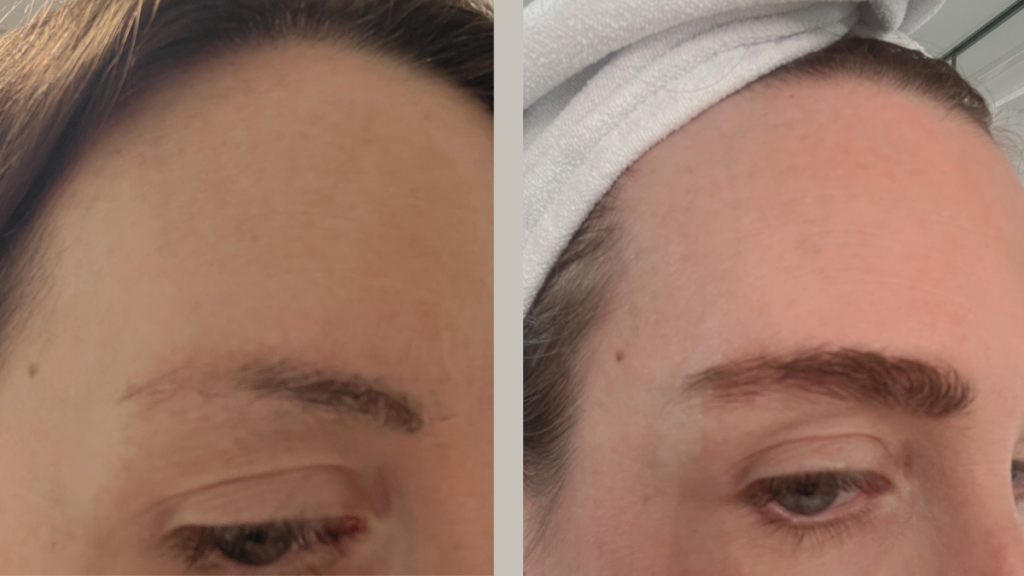
A few months ago I decided to order a brow serum that I had seen on Instagram from Nulastin. I started mid-March, and I noticed results fairly quickly, probably around the two-week mark, when little hairs started filling in the bald patches. Two months in, and I’m shocked (shocked!) that my brows are back with a vengeance. I haven’t had them professionally shaped yet (I’m waiting until I think they’re fully baked, lol), but it’s close. The funny part is that I think I need to get them tinted now, because I’ve had to tweeze out several gray hairs that came in with the rest. I’m starting to look like Groucho Marx, but I’ll take it!
Would I buy it again?
Yes, hands down.
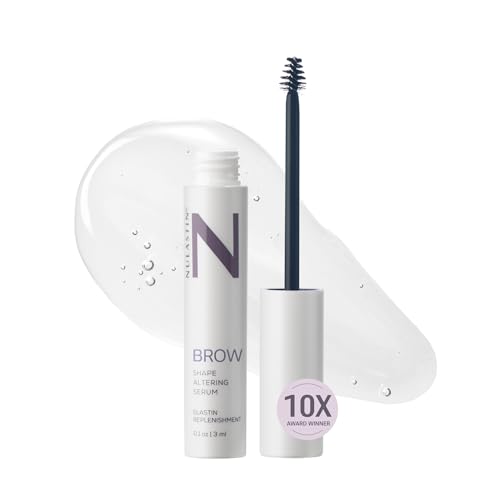
NULASTIN Shape Altering Eyebrow Serum
The one I used. Nulastin’s brow serum pairs an elastin-and-keratin complex with a small amount of isopropyl cloprostenate, the prostaglandin analog that does the actual regrowing. Two months of nightly use brought my over-plucked 90s brows back to nearly their old fullness (gray hairs and all). It’s a tiny 0.1 oz tube, it isn’t cheap, the payoff takes two to three months, and the regrowth fades if you stop. Apply to the brow only, never the lash line or the eye.
The Fine Print on Prostaglandin Brow Serums
The active ingredient. Nulastin’s regrowth comes from isopropyl cloprostenate, a synthetic prostaglandin analog in the same class as bimatoprost, the prescription active in Latisse. The elastin and keratin proteins condition the existing hair, but the prostaglandin analog is what drives new growth, by extending the follicle’s active growth phase.
Reported side effects. The effects most commonly associated with topical prostaglandin analogs are darkening of the eyelid skin, fat loss around the eye that can produce a hollowed or sunken appearance, and local redness or irritation. Published case reports describe these as largely reversible once the product is discontinued.
Iris color change. Prostaglandin analogs can permanently increase brown pigment in the iris. This risk is well established for products applied directly to the eye, such as glaucoma drops, and is low when use is confined to the brow. It is highest in people with hazel, green, or mixed-color eyes and lowest in those with solid blue eyes.
Regulatory status and the brand’s data. Isopropyl cloprostenate is not FDA-approved, while Latisse’s bimatoprost is an approved prescription drug; Canada has banned isopropyl cloprostenate in cosmetics over safety concerns, though it remains available in the U.S. Nulastin reports a 12-week study with no product-related adverse effects, though the study is brand-sponsored, 12 weeks is short relative to how gradually iris pigmentation develops, and the product is a cosmetic that has not been reviewed by the FDA. To limit risk, it should be applied to the brow only, kept away from the lower lash line and the eye.
Frequently Asked Questions
Does Nulastin contain prostaglandins?
Yes. Despite the elastin-and-peptide positioning, the ingredient list includes isopropyl cloprostenate, a synthetic prostaglandin analog, and Nulastin’s own FAQ describes it as “a precisely formulated analog of prostaglandin.” It’s the same family of ingredient that makes Latisse work (Latisse uses a prescription version called bimatoprost). The prostaglandin analog is the part that actually regrows hair.
Will it change my eye color?
It’s very unlikely from a brow serum, though it’s worth understanding the risk. Prostaglandin analogs can add permanent brown pigment to the iris, an effect well documented for Latisse used as glaucoma eye drops, where the medicine sits directly in the eye. Applied to the brow and kept away from the eye, the risk is low, and it’s lowest of all for solid blue eyes. People with hazel, green, or mixed-color eyes are the higher-risk group and should weigh it more carefully. Keeping the serum off the lower lash line is the single most important precaution.
How long does it take to see results?
Plan on two to three months of daily use before you see the full fill-in. In my case the first new hairs showed up around the two-week mark, but the fuller look took the entire two months to come in. Because the ingredient works by extending the hair’s growth phase, the new fullness fades back to your starting point if you stop using it, so it’s an ongoing commitment rather than a one-time fix.
Can I use the brow serum on my lashes too?
No. Nulastin makes a separate lash formula designed for the upper lash line, and the brand specifically warns against applying its serums to the lower lash line to reduce the risk of irritation and other side effects. The brow serum is meant for the brow. If you want both, the lash-and-brow set is the safer way to cover them rather than repurposing one product for the other.
Is Nulastin FDA-approved?
No. Nulastin is sold as a cosmetic, not a drug, and the company notes its products haven’t been reviewed by the FDA. The prostaglandin analog it uses, isopropyl cloprostenate, is not FDA-approved (Latisse’s bimatoprost is an approved drug). Canada has banned isopropyl cloprostenate in cosmetics over safety concerns, though it remains widely sold in the U.S.
What’s the difference between Nulastin and Latisse?
Both rely on a prostaglandin analog, but Latisse is an FDA-approved prescription drug containing bimatoprost, originally developed as a glaucoma medication and later cleared for lash growth. Nulastin is an over-the-counter cosmetic that uses isopropyl cloprostenate, a related analog that hasn’t gone through FDA drug approval. Latisse comes with more clinical data and a doctor’s oversight; Nulastin is easier to buy and adds its elastin-and-keratin complex on top of the growth ingredient.
Is it safe to use long term?
For most people the reported issues are local and reversible. Case reports tied to topical prostaglandin-analog serums describe darkening of the eyelid skin and a hollowed look around the eye that improved after people stopped. The way to keep risk low is to apply it only where you want hair, keep it off the eye, and pay attention to any color or contour changes around the eye area. If you have an eye condition, wear contacts, or you’re pregnant or trying to be, check with your doctor before starting, since this whole ingredient class warrants medical input in those cases.
What Our BEEs Are Buzzing About
Here’s what the beauty community is saying about brow serums:
Related Articles
- The Hair Growth Products People Say Actually Work
- 5 Makeup Mistakes That Instantly Age You
- How to Do Eye Makeup Over 50
- 6 Eye Creams That Made a Skeptic a Believer
- The Best Affordable Makeup for Women Over 50
- Anti-Aging Skincare Mistakes to Stop Making After 50
Want to become a Beauty Empties Expert?
BEEs get free products to test, exclusive discount codes from our brand partners, and live access to The Hive sessions with dermatologists and beauty editors. Spots are limited and hand-picked.
We cross-checked every product against PETA’s Beauty Without Bunnies database before publishing. Where you see our cruelty-free mark on a product card, the brand has been independently verified by PETA. Brands without it may still be cruelty-free under their own policies; we only use the mark on the PETA-verified ones.